
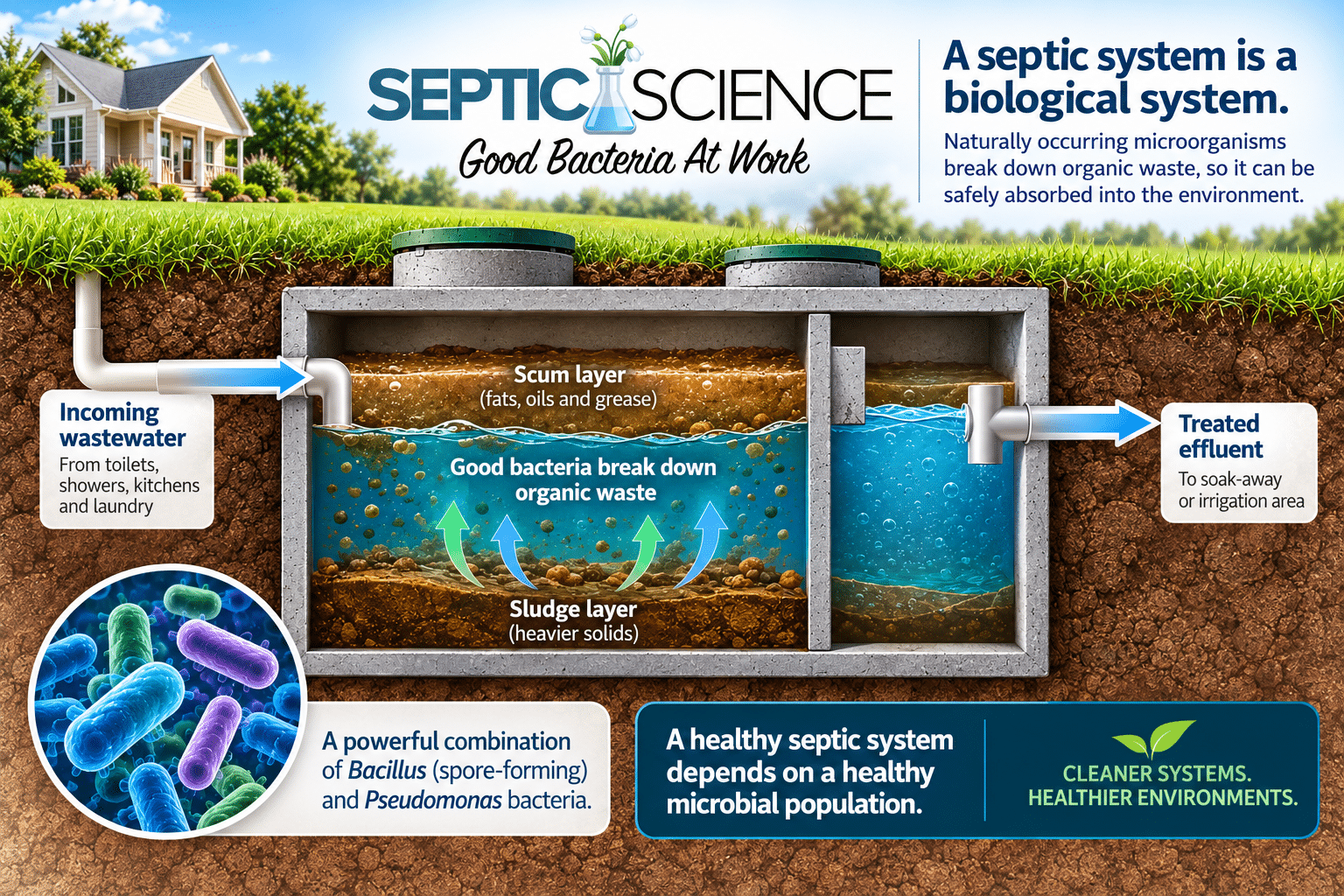
Biological treatment for the modern septic system
A septic system is a biological treatment system.
Every day, naturally occurring microorganisms work to break down the organic material entering the tank. Proteins, fats, carbohydrates, cellulose and other organic compounds are progressively broken down through microbial activity.
Septic Clean is designed to support that biological process by introducing a concentrated culture of selected microorganisms with documented enzyme-producing capabilities.
A concentrated microbial culture
The active biological ingredient in Septic Clean is RoeTech 106PS, a highly concentrated microbial culture developed for wastewater treatment applications.
According to the manufacturer’s technical specification, 106PS contains:
-
-
- Six patented Bacillus strains
-
- Two Pseudomonas species
-
- A stated concentration of 1 billion CFU per gram
- Both bacterial spores and vegetative bacteria
-
The manufacturer specifically identifies 106PS for wastewater applications including aerated septic tanks and aerated treatment units.
What does “CFU” mean?
CFU stands for colony-forming units. It is a standard microbiological measurement used to estimate the number of viable microorganisms capable of forming colonies under specified test conditions.
A specification of 1 billion CFU per gram demonstrates the high concentration of the microbial culture used in Septic Clean.
Why multiple bacterial strains?
Wastewater is not a single type of waste.
It contains a mixture of proteins, fats, carbohydrates, cellulose and nitrogen-containing compounds. Different microorganisms and their enzymes can participate in the breakdown of these different materials.
The 106PS culture is documented as producing multiple enzymes, including:
| Enzyme | Associated biological function |
|---|---|
| Protease | Breaks down proteins |
| Lipase | Breaks down fats and oils |
| Amylase | Breaks down starches and carbohydrates |
| Cellulase | Breaks down cellulose |
| Urease | Participates in the breakdown of urea and nitrogen compounds |
| Nitrate reductase | Participates in microbial nitrogen transformation |
The manufacturer describes the combination as a multiple-enzyme-producing culture, with the ability to act on standard sewage components as well as surfactants, hydrocarbons and other organic compounds.
This is one of the important principles behind Septic Clean:
Rather than relying on a single microorganism, Septic Clean uses a concentrated microbial consortium with multiple enzyme-producing capabilities.
How Septic Clean works
The basic process can be illustrated simply:
SEPTIC CLEAN
↓
Selected microorganisms enter the wastewater environment
↓
Microbial activity and enzyme production
↓
Complex organic material is broken into simpler compounds
↓
Microorganisms continue to utilise these compounds
↓
Ongoing biological degradation of organic waste
The objective is not to replace the natural biology of a septic system.
It is to supplement and support the biological population already working within the system.
The role of enzymes
A useful way to understand microbial wastewater treatment is to think of bacteria as biological factories.
The bacteria themselves are living organisms, but many of the important chemical reactions occur through enzymes produced by those organisms.
Different enzymes act on different types of organic material.
For example, proteins entering a septic tank are chemically different from fats and oils. Starches are different again, while cellulose requires yet another type of enzymatic activity.
The 106PS culture is specified as producing a range of enzymes capable of acting on these different classes of organic material.
This provides the biological basis for the broad-spectrum activity of Septic Clean.
Why Bacillus?
A significant component of the 106PS culture is made up of Bacillus organisms.
Many Bacillus species have the ability to form highly resistant dormant structures known as spores.
This is particularly useful when microorganisms are formulated into a dry product.
In the dormant state, the organisms can remain metabolically inactive until conditions allow them to become active again.
The 106PS specification describes the product as a concentrated mixture of spores and vegetative bacteria.
This combination provides both a concentrated microbial population and the durability associated with spore-forming organisms.
Designed for wastewater conditions
Microorganisms are affected by their environment.
Temperature, pH and oxygen availability can all influence microbial activity.
The manufacturer’s specifications for RoeTech 106PS identify:
pH: 6–10
Temperature: 5°C–55°C
Oxygen: Aerobic and facultatively anaerobic conditions
These characteristics are relevant to wastewater treatment, where environmental conditions can vary considerably.
They do not mean that every septic system will provide ideal conditions at all times. Rather, they describe the operating characteristics specified for the microbial culture itself.
Supporting the natural septic process
A healthy septic system already contains a complex microbial community.
Septic Clean is therefore not intended to replace that natural biological activity.
Instead, its purpose is to introduce a concentrated population of microorganisms with known biological characteristics into the system.
The concept is known as bioaugmentation — supplementing an existing microbial population with selected microorganisms.
The manufacturer’s technical material identifies applications for 106PS across wastewater treatment, including aerated septic systems and treatment units.
What makes Septic Clean different?
There are many products marketed simply as “septic bacteria”.
The important question is not merely:
“Does the product contain bacteria?”
The more useful questions are:
What microorganisms are being used?
How concentrated are they?
What biological capabilities have been documented?
What types of enzymes can they produce?
Have the organisms been developed for wastewater applications?
Septic Clean is based on a defined, highly concentrated microbial culture with documented characteristics rather than an unspecified bacterial mixture.
1 billion CFU/g
6 patented Bacillus strains
2 Pseudomonas species
Multiple enzyme-producing capabilities
Developed for wastewater applications
What the science tells us
The science behind Septic Clean is based on established biological principles:
Microorganisms break down organic matter.
Different microorganisms can perform different metabolic functions.
Enzymes enable microorganisms to break down complex organic compounds.
Bacillus organisms can form resilient dormant spores.
A concentrated microbial population can be used for biological wastewater treatment.
RoeTech’s technical documentation specifically identifies 106PS as a highly concentrated, multiple-enzyme-producing microbial culture for wastewater applications.
What we don’t claim
At Septic Science, we believe technical credibility depends on being clear about the difference between scientific evidence and marketing claims.
Septic Clean is not presented as a substitute for correct septic-system design, maintenance or professional servicing.
A microbial treatment cannot compensate for every possible septic-system problem. Hydraulic overload, damaged or blocked components, unsuitable soil conditions, structural problems and other mechanical or environmental issues require appropriate investigation and remediation.
The performance of any biological treatment can also be affected by conditions within the individual system, including temperature, pH, wastewater loading and other environmental factors.
Our claim is more straightforward:
Septic Clean provides a highly concentrated, multi-strain microbial culture with documented enzyme-producing capabilities designed to support the biological processes occurring within wastewater treatment systems.
Science-based. Microbiology-driven.
Septic Science was founded on a simple principle:
A septic system is a biological system — so its treatment should be based on biology.
Septic Clean uses concentrated microbial technology developed specifically for wastewater applications and combines multiple bacterial strains and enzyme-producing capabilities in a practical treatment product.
We continue to investigate the science behind biological wastewater treatment and to build our understanding from published research, technical data and real-world experience.
Because good wastewater treatment starts with good biology.
Technical information
Active microbial culture: RoeTech 106PS
Manufacturer: RoeTech / Roebic Technology Inc.
Stated microbial concentration: 1 × 10⁹ CFU/g
Microbial composition: Six patented Bacillus strains + two Pseudomonas species
Documented enzymes: Protease, urease, lipase, cellulase, amylase and nitrate reductase
Specified pH range: 6–10
Specified temperature range: 5°C–55°C
Oxygen characteristics: Aerobic / facultatively anaerobic
Technical source: RoeTech 106PS manufacturer specification and RoeTech wastewater-treatment technical documentation.